To understand the emergence of Stamford Brook as a London suburb, one must first understand London's long evolution from provincial trading city to vibrant metropolis. When Stamford Brook first appeared in records, it was a remote hamlet on the edge of Turnham Green, one of the four ancient villages that would go onto make up modern Chiswick, (the others being Sutton, Strand-On-The-Green, and Old Chiswick itself). People living here would probably never travel to the next town let alone visit the distant city.
![]()
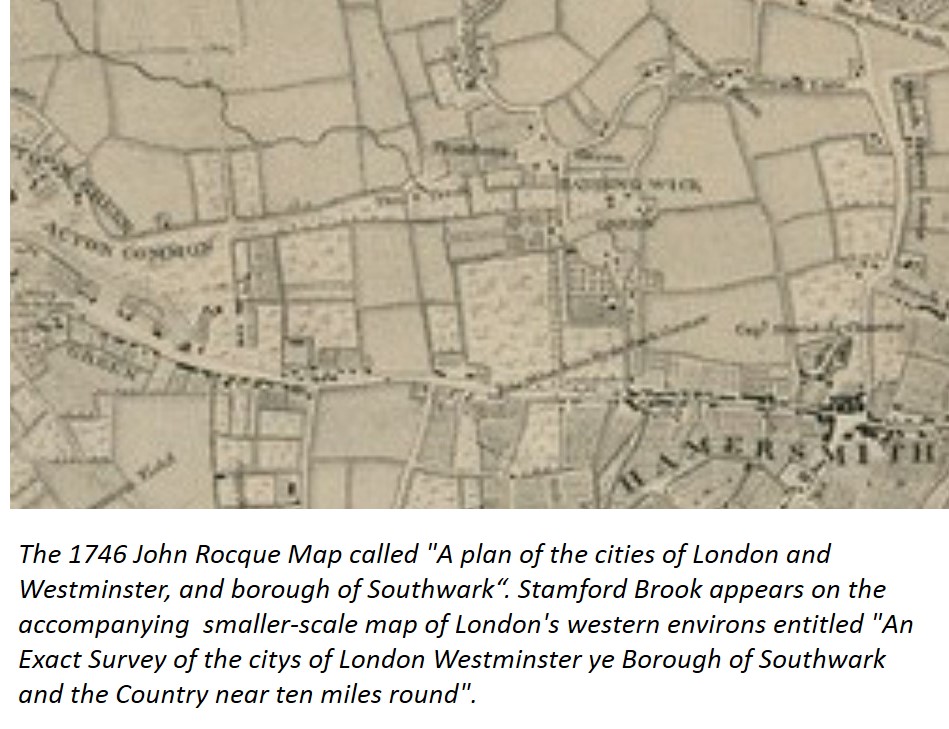 Set back from the main road from London to the West, Stamford Brook was separated from the City by miles of heath, farms, and market gardens; as well as towns like Hammersmith, Tyburn and Chelsea. This whole area fell into the old county of Middlesex, which originally surrounded the north and western sides of the City. Chiswick was 'in the country' and was the location of various large farms and country estates owned by rich city traders.
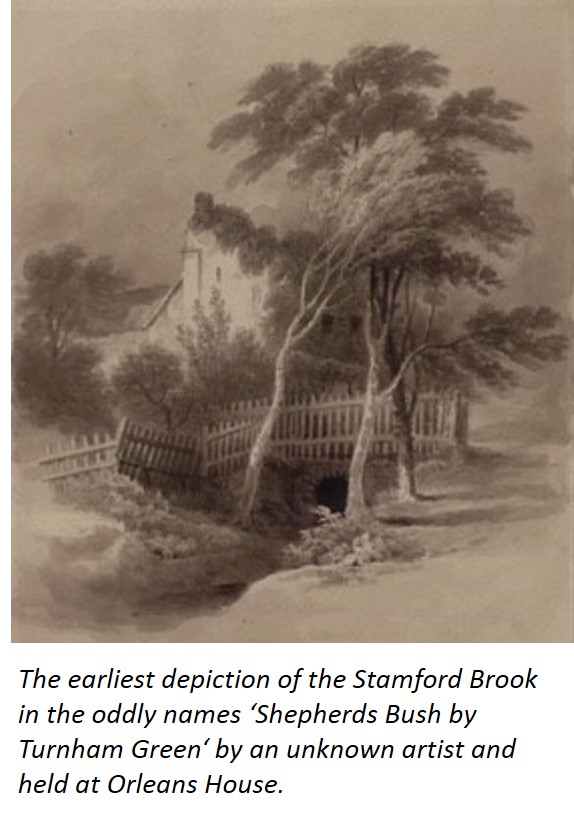
By the 16th century, a small cluster of cottages had emerged around Stamford Brook Common. As the City grew in importance, Stamford Brook became the location for a series of large country houses. By the 18th century, four large houses dominated this part of Stamford Brook, including 'The Brook', where artist Lucien Pissarro lived, and Stamford Brook House. At this point, Stamford Brook Common was an extension of the common land of Turnham Green. However, by the nineteenth century, the space between these two open areas began to be developed.
Stamford Brook As A Boundary Town
Having spent most of the second millenium in the ancient county of Middlesex, in the last two hundred years Stamford Brook became an ever-changing boundary between various London government entities. The City of London had operated as bastion of self rule for centuries, while surrounded by the County of Middlesex, whose county town was Westminster. However by the nineteenth century the metropolis has extended its influence and a 'greater' London existed in all but name. In 1888 the Local Governent Act carved out a huge swathe of Middlesex, Essex, Kent and Surrey to create the 'County of London'. The boundary between this new County and the rump of Middlesex ran along the eastern edge of Stamford Brook, along the back of the houses on Stamford Brook Common and up to Chiswick High Road at Young's Corner. Hammersmith was 'in' and Stamford Brook (along with Turnham Green and the rest of Chiswick) remained 'out' in the wilds of Middlesex.
In 1965, a new Local Government Act finally removed the last vestiges of the County of Middlesex and incorporated its territory into a new Greater London. The constituent towns of Chiswick were given to the newly created Hounslow Borough, and Stamford Brook became the border between Hounslow and a combined Hammersmith & Fulham. However, confusion still reigned, as the border cut unevenly through the area, even cutting one house, 65 Emlyn Road in half. In 1994 the boundary between the two boroughs was finally moved to follow the old 'middle stream' of the Stamford Brook, moving Emlyn Road into Hammersmith and Fulham for administrative purposes.
Also see: The Brickfields of Stamford Brook and The Train Comes to Stamford Brook